Atlas entry
Mummy Name Generator
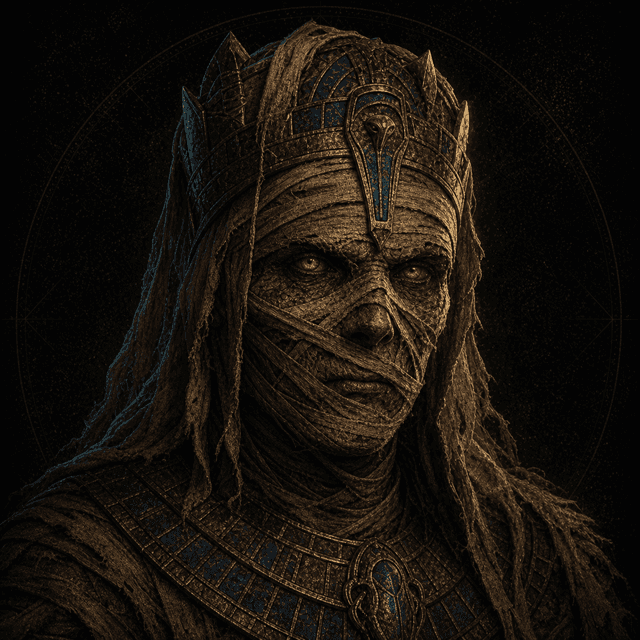
Mummy names assembled from ancient Egyptian-inspired roots, crowned with tomb titles evoking dynasties, sacred offices, royal curses, and the authority of the dead.
Generator
Mummy Name Forge
Inspect each name, lock the ones you like, and favorite the ones you want to keep.
Name ideas
Example Mummy names
A sample of Mummy names from the generator above. Roll the tool for a fresh batch, then lock and save the ones that fit.
- Nebenra Keeper of the Buried Crown
- Ptahankh of the Endless Reign
- Neithat
- Aakhet
- Khaneferet Guardian of the Silent Halls
- Amenidat the Ancient
- Wahenra Warden of the Bitter Ash
- Taruit
- Nefkhara Hand of the Buried Sun
- Nedumet
- Sebenit
- Horemka Keeper of the Sunless Court
- Nefankh
- Senmara Guardian of the Forgotten Name
- Sekhenet
- Khonsit
- Neferkau
- Merikhamun
A good mummy name works in two layers stacked on top of each other. The bottom layer is the sound of ancient Egyptian itself, built by fusing short meaning pieces like nefer or hotep the way real names such as Amenhotep were built. The top layer, optional but powerful, is a throne title borrowed from real pharaonic pomp and twisted toward the grave, turning a buried person into a mummy that will not stay dead.
How the name is built
The opening quality or god word, like Nef-, User-, or Seb-, that sets the meaning at the front of the name, drawn from real Egyptian name pieces.
The anchor that closes the given name, often a god sound like -amun or -ra, or a peace word like -hotep. A trailing -et signals a feminine name.
An optional epithet after the name, styled on real pharaonic titulary but tilted toward the grave, such as 'the Undying' or 'Keeper of the Weighing Scales'.
Do's and don'ts
Do
- Fuse two short Egyptian sounding elements into one given name, like nef plus hotep, instead of stringing many pieces together.
- Save the grand throne title for a buried king or queen the story wants you to fear, not for every mummy in the tomb.
- End a name in -et, -it, or -at when you want it to read as a woman's name, as in Neferitet or Sitamet.
Don’t
- Don't rely on rules like 'ends in a vowel means male', real ancient Egyptian names do not split that cleanly by sound.
- Don't lift a real pharaoh's full name wholesale, like Ramesses or Tutankhamun, build something new from the same pieces instead.
- Don't stack more than one throne title on a name, a second epithet dilutes the dread instead of adding to it.
- {given} alone reads as a priest or servant glimpsed once; {given} plus a throne title reads as the buried ruler running the plot.
- Hard sounds like k and kh, plus a breathy h, carry the ancient Egyptian texture, so keep at least one in the given name.
- Throne titles usually run 2 to 4 words and lean on 'the X' or 'Keeper, Lord, or Warden of X' phrasing.
Famous names, decoded
Imhotep
The Mummy (1932 and 1999 films), Universal; the name is borrowed from a real ancient Egyptian official
The -hotep ending is a real peace word, so the name sounds calm and settled on the surface, which is exactly why it works so well for a cursed high priest hiding menace under formality.
Ahmanet
The Mummy (2017 film), Universal
Opens on a breathy ah, carries the god sound amun in the middle, and closes on the -et sound that reads feminine in Egyptian names, a clean template for building an invented mummy queen.
N'Kantu the Living Mummy
Marvel Comics, first appearing 1973
Splits cleanly into a given name with a hard k sound and a plain descriptive title, proving a mummy's title does not need pharaonic flourish, a simple label like 'the Living Mummy' can carry the dread on its own.
Roots and elements
| Nef- | a shortened form of nefer, meaning beautiful or good in ancient Egyptian | Nefhotep the Undying |
| Nefer- | beautiful, good, perfect; attested across ancient Egyptian names | Neferitet the Undying |
| Ankh- | life; the ankh sign meant life in ancient Egyptian | Ankhmose |
| -hotep | peace, contentment, an offering; a real ending seen in names like Amenhotep | Sebhotep Warden of the Bitter Ash |
| -amun / Amen- | the hidden one, the god Amun; a common name anchor in ancient Egypt | Ahmanet |
| -mose / -mes | born of, child of; the ending in real names like Thutmose | Ankhmose |
| Neb- | lord, master; a genuine Egyptian title word used in names | Nebsura Guardian of the Hidden Chamber |
| Meri- / Mery- | beloved; attested in ancient Egyptian names and epithets | Merenka the Forgotten |
| Ka | the spirit double or life force that survives death in Egyptian belief | Merenka the Forgotten |
| -ra / Re | the sun god Ra; a frequent divine anchor in royal names | Userra Keeper of the Weighing Scales |
| Sekhem- | power, might; a real Egyptian word for divine or royal strength | Sekhemka |
| Heka- | magic, and the name of the god who personified it in Egyptian belief | Hekamun |
| Djed- | stability; the djed pillar was a symbol of endurance and the god Osiris | Djedetari the Unbroken |
| User- | powerful, strong; the opening of real names such as the historical Userkaf | Userra Keeper of the Weighing Scales |
| -et / -it | a trailing t sound that marked many women's names in ancient Egyptian | Neferitet the Undying |
| the Undying / the Unbroken / the Forgotten | grave tilted throne epithets, a modern mummy fiction habit of twisting royal titles toward undeath | Nefhotep the Undying, Wserhotep the Unbroken |
Frequently asked
what makes a name sound like a mummy and not just an Egyptian name?
The Egyptian sound gives you the base layer, the fused elements and hard k and h sounds. The mummy feel comes from adding a throne title that leans toward the grave, like the Undying or Keeper of the Weighing Scales. The name alone reads as a person, the name plus that dread soaked title reads as a mummy.
should i add a throne title or keep it to the name?
Keep it to the given name for a priest, servant, or a mummy glimpsed only in passing. Add a title when the character is a buried king or queen and the scene needs that weight. The pattern makes the title optional on purpose, so use it as a dial rather than a default.
are these real pharaoh names i can look up?
No, these are invented using the same building blocks as real ancient Egyptian names, but they are not names of actual kings. Real pharaohs and famous fictional mummies like Imhotep are deliberately kept out of the generator's pool.
how do i tell a male mummy name from a female one?
Real Egyptian names do not split neatly by sound, so treat any single rule with suspicion. The most reliable feminine signal is a trailing t sound spelled -et, -it, or -at, as in Neferitet or Sitamet. Endings like -amun, -hotep, and -mose lean male in this style.
can i use god names like anubis or osiris in the name?
God sounds are the heart of this style, so anchors like -amun, -ra, or elements tied to Set work well fused into an invented name. Using a full god name unchanged tends to read as the god itself rather than the mummy, so blend it into a fused word instead.